Story of Imam Musa al-Kazim and a descendant of ‘Umar b. al-Khattab

Story of Imām Mūsā al-Kāẓim and a descendant of ‘Umar b. al-Khaṭṭāb

Translated by Shabbir Agha Abbas

We find in Tārīkh al-Baghdād, continuing Ḥasan b. Muḥammad b. Yaḥyā al-’Alawī’s (d. 358/969) narrative of the life of Imām al-Kāẓim (d. 183/799) based on his grandfather Yahyā b. al-Ḥasan’s* report.

The report is as follows:

“My grandfather mentioned to me that in Madinah, a man from the descendants of ‘Umar b. al-Khaṭṭāb was once speaking ill and insulting ‘Alī b. Abī Ṭālib. In response some from the retinue of Imām al-Kāẓim cried out: “let us kill him!”

However, the Imām prohibited them and rebuked them severely, and he asked the whereabouts of this ‘Umarī, and it was mentioned to him that he was farming in the outskirts of Madīnah. Imām al-Kāẓim rode to him at his farm finding him therein, and he entered his farmland without dismounting from his donkey. 

The ‘Umarī angrily cried out: “do not trample my crops!” 

But the Imām ignored his pleas, and he continued on towards him trampling the crops with the hooves of his donkey, and it was not till he reached the ‘Umarī that he dismounted and sat with him with a smile on his face, and he asked him: 

“How much did you spend on these [now ruined] crops of yours?”
The ‘Umarī responded: “one hundred dinars.”
The Imām then asked: “And how much did you hope to get from it?”
The ‘Umarī [sarcastically] said: “I do not possess ‘Ilm al-Ghayb.”
The Imām responded: “I only asked of you ‘how much did you hope to get from it?’”
The ‘Umarī answered: “I hoped to get two hundred dinars.”
And the Imām then said: “I give for it [these ruined crops] three hundred dinars.”
And the ‘Umarī [gratefully] responded: “These crops are yours upon this [ruined] state.” 

Then my grandfather said that the ‘Umarī stood up and kissed the Imām’s head and left. Later on Imām al-Kāẓim went to Masjid al-Nabawī and found the ‘Umarī sitting, and when he [the ‘Umarī] saw the Imām he exclaimed [in praise of the Ahl al-Bayt]:  

ٱللَّهُ أَعۡلَمُ حَيۡثُ يَجۡعَلُ رِسَالَتَهُ
“Allah knows best where He places His message” (Qur’ān 6:124) 

My grandfather said that upon hearing this the Imām’s companions jumped in shock asking: 

“What is your story? You used to say the opposite of this!” And they quarreled.

He then explained that this descendant of ‘Umar continued to announce this Qur’ānic declaration in honor of Abū al-Hasan Mūsā [al-Kāẓim] whenever the Imām entered or exited Masjid al-Nabawī. 

Abū al-Hasan Mūsā [didactically] asked his retinue, knowing that they once desired to kill this ‘Umarī: 

“Which is from goodness, what you wanted (his death)? Or what I wanted, the correcting of his destiny?”

(Relevant section from Tārīkh al-Baghdād (v. 13, p 30) below)

2020-03-20 (2)

* Yahyā b. al-Ḥasan was was one of the teachers of al-Shaykh al-Ṣadūq (d. 381/991), and he was an important ‘Alid

Economic Justice in the Qur’an; Our Personal Responsibility

https___s3-us-west-2.amazonaws

Economic Justice in the Qur’an; Our Personal Responsibility
By Agha

When it comes to the practice of ‘American’ Islam, it seems that there is a hyper-focus on building, maintaining, and expanding mosques. While there is no doubt that mosques represent the heart of Islamic life, where we seek guidance and education, as well as spiritual rejuvenation; it is however necessary to state that we cannot assume that achieving a mosque is the be-all and end-all of our duties as Muslims. In fact, the Almighty rebukes those with this mentality in the Qur’an:

أَجَعَلۡتُمۡ سِقَايَةَ ٱلۡحَآجِّ وَعِمَارَةَ ٱلۡمَسۡجِدِ ٱلۡحَرَامِ كَمَنۡ ءَامَنَ بِٱللَّهِ وَٱلۡيَوۡمِ ٱلۡأَخِرِ وَجَـٰهَدَ فِى سَبِيلِ ٱللَّهِ‌ۚ لَا يَسۡتَوُ ۥنَ عِندَ ٱللَّهِ‌ۗ وَٱللَّهُ لَا يَہۡدِى ٱلۡقَوۡمَ ٱلظَّـٰلِمِينَ
“Do you consider the providing of drinking water to the pilgrims and the maintenance of Masjid al-Ḥarām (at Makkah) as equal to the worth of those who believe in Allah and the Last Day, and strive hard and fight in the Cause of Allah? They are not equal before Allâh. And Allah guides not those people who are wrong-doers.” (9:19)

As the historical records explain, the uncle of the Prophet Muḥammad (s), ʿAbbās b.ʿAbd al-Muṭṭalib was assigned the duty of Siqāyat al-ḥājj, to provide water and care for the pilgrims. Which meant his role was not at any mosque, but to Masjid al-Ḥarām itself, the central and most sacred site for all Muslims. ʿAbbās had supposedly boasted to his nephew, Imām ʿAlī, of the importance and honor of his assigned role, he assumed that by serving in this role he was thus performing his due diligence to the faith. This angered the Almighty, and he revealed that while maintaining mosques are virtuous tasks, they do not at all compare with the acts of those like ʿAlī who engage in jihād, striving to implement righteousness in society. Likewise, we cannot afford to conclude that by building and maintaining mosques we have somehow performed due diligence; no, we need to escape the confines of our respective mosques.
We need to explore and find issues to solve in society, we must strive to make our surroundings better. To do this we need to firstly delve into the Qur’an, understand the divine ethos, and then take action. The Almighty thus directly addresses the believers:

يَا أَيُّهَا الَّذِينَ آمَنُواْ كُونُواْ قَوَّامِينَ بِالْقِسْطِ شُهَدَاء لِلّهِ وَلَوْ عَلَى أَنفُسِكُمْ أَوِ الْوَالِدَيْنِ وَالأَقْرَبِينَ
“O you who believe! Stand firmly for justice, as witnesses to Allah, even though it be against yourselves, or your parents, or your kin…” (4:135)

Therefore, one of, if not the central ethos of Islam, is the upholding of justice. Correspondingly, without any doubt the greatest injustice in America and possibly the world is economic inequality. Thus our jihād is to actively fight against income inequality, to become warriors for the impoverished; this is our personal [wājib al-ʿAynī] responsibility outside the mosque.
However, when it comes to this issue, we find Muslims to be utmostly confused, becoming lost in the arguments between capitalism and socialism, and my response to this bewilderment is that we Muslims recognize neither. Without getting into the messy discussion of statehood, and governance, we can all agree that in the life of the Prophet (s) and within the divine revelation- the Qur’an, there are enough directives and injunctive examples for us to determine our individual economic philosophy. It simply is, that fundamentally humankind owns nothing, whatever it is belongs to Him:

وَهُوَ ٱلَّذِى فِى ٱلسَّمَآءِ إِلَـٰهٌ۬ وَفِى ٱلۡأَرۡضِ إِلَـٰهٌ۬‌ۚ وَهُوَ ٱلۡحَكِيمُ ٱلۡعَلِيمُ (٨٤) وَتَبَارَكَ ٱلَّذِى لَهُ ۥ مُلۡكُ ٱلسَّمَـٰوَٲتِ وَٱلۡأَرۡضِ وَمَا بَيۡنَهُمَا وَعِندَهُ ۥ عِلۡمُ ٱلسَّاعَةِ وَإِلَيۡهِ تُرۡجَعُونَ (٨٥)
“It is He, Allah, Who is the only deity in the heavens and the only deity on the earth. And He is the All-Wise, the All-Knower. And Blessed is He to Whom belongs the kingdom of the heavens and the earth, and all that is between them, and with Whom is the knowledge of the Hour, and to Whom you (all) will be returned.” (43:84-85)

Nevertheless, Islam does recognize the concept of private property, in that the Almighty deputized humankind over the [material] earth (إِنِّى جَاعِلٌ۬ فِى ٱلۡأَرۡضِ خَلِيفَةً۬‌ۖ); meaning that ownership is a divinely protected right. Whatever one has gained through just means, it cannot be taken from them by any other human. However, this ownership cannot be understood as ownership in the capitalistic sense, ownership herein refers back to that primordial deputization; in essence ownership in Islam is managerial, the owner is God, the manager is human. Therefore, there is no qualm in seeking wealth, in fact it can be considered encouraged, albeit the ultimate decider over that wealth is God, and humankind manages it accordingly. The divine instructions for the management of wealth are thus expressed through the Islamic system of rights, or Ḥuqūq.
For those of us who possess wealth, Qur’anically we are informed, that there are other human beings who have a ḥaqq (right) over ‘our’ wealth:

وَٱلَّذِينَ فِىٓ أَمۡوَٲلِهِمۡ حَقٌّ۬ مَّعۡلُومٌ۬ (٢٤) لِّلسَّآٮِٕلِ وَٱلۡمَحۡرُومِ (٢٥)
“And those who possess wealth within it there is a recognized ḥaqq (right), a [right] for the needy who asks, and for the downtrodden” (70:24-25)

The very existence of needy and the downtrodden informs us that, those with wealth are not giving the ḥaqq to their rightful owners. Nevertheless, the question thus arises here, what percentage of our wealth is this ḥaqq? How much must be given away, and the Almighty responds:

وَيَسۡـَٔلُونَكَ مَاذَا يُنفِقُونَ قُلِ ٱلۡعَفۡوَ‌ۗ
And they ask you [O Muhammad (s)] what they ought to spend [in the way of Allah]. Say: “That which is beyond your needs.” (2:219)

Meaning, that after we account for the needs of our household, whatever is superfluous we return to the Almighty, hence this ḥaqq is actually from the rights of God (Ḥuqūq Allah). It is thus completely antithetical to the spirit of Islam for one to hoard their wealth, yet we live in a society where millions starve, whilst individuals possess billions. If Islamic economic philosophy were to be considered anything, it would most definitely be militantly against this perversion.

God’s ḥaqq is our fulfilling of the needs of the impoverished, of the suffering; it is our personal [and societal] responsibility to answer to the Ḥuqūq Allah (rights of God), by tending to the poor. If Ḥuqūq Allah belongs to the impoverished, to the suffering, then we can say that this poverty this suffering in this world in itself is a divine manifestation, when we see the hands out-stretch on the streets of Manhattan, when we see pictures of starving emaciated children in Yemen, when we see the refugees crossing the Mediterranean, we should understand this as the Almighty Himself demanding His rights; and we must not deny the Almighty.

Please also read:

Young Muslims Need to be Radical, Capitalism is Jāhilīyyah!

https://ahlulbaytblog.com/2018/02/25/young-muslims-need-to-be-radical-capitalism-is-jahiliyah/

Días de Los Muertos an Exercise of Resistance

hqdefault

Días de Los Muertos an Exercise of Resistance

In the previous few centuries there has probably been no group of peoples that has faced more violent oppression and cultural erasure than the indigenous populations of the Americas, specifically those once held by the Spanish empire. These Spanish colonizers barbarically slaughtered, pillaged, and raped the natives en masse; forcing them to abandon their beliefs and to instead convert to their skewed understanding of Catholicism, whose supposed deity sanctioned these atrocities. In response to this oppression many forms of resistance have arisen, of which the most peculiar is Mesoamerican and Chicano communing with the dead.

For a people who were stripped of their way of life, their languages, beliefs, and living with a constant threat of the sword, not much could be done in form of resistance, but what could be done is remembrance, remembrance of their departed loved ones. If practicing the ways of the ancestors was forbidden, then the simple act of remembrance of those very same ancestors would be an act of defiance. This is precisely what the Mesoamerican and Chicano populations have sought and achieved in their public rituals of Días de Los Muertos.

During the holiday, artistic renditions of the calavera (human skeleton) decorate homes and city centers, while paraders march through the streets chanting “vivan los muertos” (long live the dead!), all which allude to the enduring presence of the dead; that their memories live on. In order to appease Catholic sensibilities, ofrendas (altars) are made centered around Christian imagery, such as iconography of Mother Mary or our Lady of Guadalupe. These Catholic elements share space upon the ofrendas with indigenous symbols, herbs, earth, water, fire, symbols of the mother Coatlicue. This convergence allows for suppressed and relegated practices to survive under the garb of colonially-imposed religion, thus allowing for indigenous traditions to pass on through the generations.

However the most telling are the poems and songs dedicated to Días de Los Muertos, an example of which is that of the popular Southern Californian Chicana poetry group En Lak Ech (Mayan: You are my other me). A prayer that this group composed to be a ritualized recitation on the given day, perfectly conveys the inherent message of Días de Los Muertos:


“We would like to offer you all, in a good way, in a humble way, a prayer song.

We would like to honor all those who have passed on, all our ancestors, our grandmothers, and our grandfathers.

We want to pray for those who are yet to come and those that are here present with us today. We, En Lak Ech mujeres, pray to the women and mujeres who have died through violence or through life and struggle.

We offer this prayer for you.”


The celebration of Días de Los Muertos is firstly a form of healing for this marginalized community, for those who historically have suffered from brutal violence, and then it is a grand statement that although many have died upon the struggle, many new are willing to continue the fight into the future.

Now, many might be wondering what all of this has to do with the Ahl al-Bayt (‘a) and why it is being shared on the ahlulbaytblog.com, but the reality is for a community that partakes in ‘Azā this is very relevant. The ritualized mourning of ‘Azā, like the Mesoamerican and Chicano communion with the dead, is centered around two objectives, firstly the remembrance of the oppressed who were brutally martyred, specifically the descendants of the Prophet (s) [and their loyalists], and secondly to continue their mission of reformation, of social justice.

Two socio-religious entities, possessing totally unrelated genealogies, retaining similar goals and methods, tells us that humankind innately is drawn towards the same values of goodness and righteousness. One group might resist by celebrating Días de Los Muertos, the other might resist in the mourning of ‘Azā; fundamentally however, both present themselves as a crushing slap in the face of oppression.

Understanding similarities such as these is crucial for the struggle, for it is these similarities which allow us to build upon our movement, these similarities that grant us allyship; allyship which grants us lasting victory.


Written by: Agha Shabbir Abbas

Marriage is Half of Dīn, Not Isrāf: What we learn from the wedlock of ‘Ali (‘a) and Fatimah (s)

Prophet-Muhammad-giving-Fatima-in-marriage-to-Ali-Siyer-Nabi

Marriage is Half of Dīn, Not Isrāf: What we learn from the wedlock of ‘Ali (‘a) and Fatimah (s)

By: Agha Shabbir Abbas

As the marriage of Fatimah (s), the most-beloved daughter of Muhammad (s), to ‘Ali b. Abi Talib (‘a) took place on the first of Dhū al-Ḥijjah, it is imperative to derive some lessons for our own matrimonies on its anniversary date.

For us Muslims, the Sunnah (the practices) of the Messenger of God, are set-precedents guiding and governing our daily affairs; we seek to emulate al-Mustafa (s) in everything we do. Therefore, his steering principles in the marriage of his daughter, should too steer our course of affairs when in the pursuit of union.

Now amongst the plethora of lessons found within this holy sacrament, from the esoteric and metaphysical to the many worldly lessons, the simplest to grasp for the laity is the rejection of economic demands and the upholding of the intrinsic worth of man.

The Prophet of Islam, in the eyes of his followers was the representative of God, the axis connecting mankind to the Divine, and for the Arabs in general he was the chieftain of Madinah, in all he occupied the most reverent position of peninsular Arabia. Therefore, when al-Zahra (s) reached the age of marriage, suitors possessing the greatest of gravitas came to the doorstep of the Prophet (s) in hopes for attaining her hand. Immeasurable amounts of wealth was being offered, but one by one the Prophet (s) on behalf of his daughter rebuked and rejected the materialistic proposals, of which ‘Abd al-Rahman b. ‘Awf and ‘Uthman have been made as examples in the texts of history.

روى الشافعي محمد بن أدريس، عن حميد الطويل، عن أنس بن مالك، قال: ورد عبد الرحمان ابن عوف الزهري، وعثمان بن عفان إلى النبي صلى الله عليه وآله فقال له عبد الرحمان: يا رسول الله تزوجني فاطمة ابنتك؟ وقد بذلت لها من الصداق مائة ناقة سوداء، زرق الاعين، محملة كلها قباطي مصر، وعشرة آلاف دينار… وقال عثمان: بذلت لها ذلك، وأنا أقدم من عبد الرحمان إسلاما. فغضب النبي صلى الله عليه وآله من مقالتهما، ثم تناول كفا من الحصى فحصب به عبد الرحمان، وقال له: إنك تهول علي بمالك ؟ (قال:) فتحول الحصى درا، فقومت درة من تلك الدرر فإذا هي تفي بكل ما يملكه عبد الرحمان، وهبط جبرئيل في تلك الساعة، فقال: يا أحمد، إن الله يقرئك السلام، ويقول: قم إلى علي بن أبي طالب عليه السلام، فإن مثله مثل الكعبة يحج إليها ولا تحج إلى أحد..

‘Abd al-Rahman b. ‘Awf said to the Prophet (s): “O Messenger of Allah, may I marry Fatimah, your daughter? I offer in dowry a hundred black camels, blue-eyed, carrying upon their backs the riches of Egypt, and on top of that ten thousand dinars.”

Hearing this ‘Uthman said: “I offer the same, but I entered the fold of Islam prior to ‘Abd al-Rahman.” Hearing this materialistic discussion the Prophet (s) became angry, and tossed a handful of pebbles at ‘Abd al-Rahman b. ‘Awf saying: “You thought I would be swayed by money!?”

By prophetic miracle, the pebbles thrown at ‘Abd al-Rahman transformed into pearls, worth more than the entirety of his wealth. At that moment, Gabriel descended and said: “O Ahmad, verily Allah conveys his peace upon you, He says: “Go to ‘Ali b. Abi Talib (‘A), for truly his example is that of the Ka’aba, pilgrimage is only made to it and pilgrimage is made to nothing else…”

We learn from this that no matter how wealthy a suitor is, and no matter how large the dowry being offered is, the sanctity of marriage is priceless. By putting a price on it, marriage is being abased, it is being devalued.

So, when ‘Ali (‘a) approached the Prophet (s) concerning marrying Fatimah (s), he informed the Prophet (s) of how little he had:

قال: يا رسول الله، إني لا أملك إلا سيفي وفرسي ودرعي. فقال له النبي صلى الله عليه وآله: اذهب فبع الدرع

‘Ali (‘a) said: “O Messenger of Allah, I possess nothing except for my sword, my steed, and my shield. The Prophet (s) responded: “Bring your shield, and sell it.”

All the money in the world was not enough to attain the hand of Fatimah (s), but the shield of ‘Ali (‘a) was sufficient to fulfill the right of a dowry. Why?

قال: لو لم يخلق الله علي بن أبي طالب ما كان لفاطمة كفو

The Prophet (s) said: “If Allah had not created ‘Ali, there would be no equal (suitable match) for Fatimah”

Therefore, the criterion for marriage should not be based on wealth, but instead on the worth of the individuals being married, are the two worthy for each other. Do they better each other’s spiritual and internal existence, do they comfort each other? The bringing of two individuals together should result in harmony, this is why Islam tells us that:

من تزوج فقد استكمل نصف الدين
“Those who marry perfect half their dīn.”

However, when we return to the marriages of our current era, it seems we have strayed far from the set-precedent of ‘Ali (‘a) and Fatimah (s). Marriage may perfect half of one’s faith, but what about the isrāf (excesses) demanded on the newlyweds by society? Exorbitant dowries imposed by in-laws, and lavish ceremonies wherein the bride and groom know not most of the people. Is $50,000+ in crippling debt truly an appropriate cost for getting married; and that’s not even mentioning the massive student debt our young people are already burdened with. Is it fair that two perfectly compatible beings are prevented from being married because of differing socioeconomic statuses?

When the daughter of the greatest in creation, who herself is the greatest of women, can reject the treasures of this world in favor of a shield as dowry, we must stop, reflect, and rectify. Why not us?


Knowledge is Power; Muslims Powerless?

screenshot_20180703-045144__017046205978834283217.png

Knowledge is Power; Muslims Powerless?
By Agha Shabbir Abbas

Nearly 400 years ago, the English philosopher Francis Bacon proclaimed ‘Knowledge is Power’ (scientia potentia est); the veracity of this maxim is unquestionable as the nations wielding the most power today too are home to the best of universities, the foci of global learning. It is more than evident that the power and might of a people is directly related to their attachment to education. So, in a time when Muslims and Muslim-majority nations seem powerless, the question to be asked is does Islam forgo the importance of knowledge and education?

The truth is to the contrary, the Prophet Muhammad (ṣ) a millenium prior to Francis Bacon not only exhorted to the merits of education but also that striving for it is an obligation.

طلب العلم فريضة على كلّ مسلم
“It is the duty of all Muslims to seek knowledge”
(Kitāb al-Shihāb, 1.138)

Like the other compulsory rituals (ṣalah, ṣawm, etc) imposed by the religion, seeking knowledge too is incumbent for all Muslims, and when the Prophet declares all he includes both genders. So either Muslims are absconding from their duties or they are terribly mistaken as to what knowledge is. Without having to delve into an investigation, the simple fact is Muslims feel powerless today because as a community they are far from education, far from learning.

There are many valid reasons as to why this is so, colonialism and imperialism definitely factor in this, and so does political tyranny and corruption, but at the end of the day ‘the pen is mightier than the sword.’ No political force in the history of man has ever succeeded in stopping the strokes of the pen, many have tried and all have failed. Why, because the Almighty in the Qur’an has attributed writing, the spread of scholarship, as one of His own doings, “It is He [Allah], who taught by the pen” (ٱلَّذِى عَلَّمَ بِٱلۡقَلَمِ), and truly there is no power nor might except for Allah.

So in response to oppression the Muslim must double-down on their faith and respond by writing and studying to even greater extents, and the result of this would be that the Almighty Himself would guide them through their pens onto salvation. This is not a personal interpretation or a rhetorical statement, it is instead affirmed by the teachings of our beloved Prophet:

إن الفتنة تجيئ فتنسف العباد نسفا وينجو العالم منها بعلمه
“Seditions appear and crush believers – your only salvation is your learning.”
(Kitāb al-Shihāb, 7:56)

This post-colonial era, when confusion is rampant, can only be described as a time of sedition (fitnah) and according to the words of Ḥabīb al-Muṣţafa (ṣ) nothing, not even ʾīmān (correct belief) can save the Muslim. He informs his followers that the only lifeline from sedition is the route of knowledge and learning, so what should be the course of action for Muslim communities? The answer is threefold, Muslim communities must utilize their resources, especially wealth, to empower scholars, to invest in students, and to build schools.

1. Righteous scholars, those who wield true knowledge, must be empowered by their communities. Quite simply, as the shipmaster cannot steer if his hands are tied, a scholar cannot guide the community if disempowered.
2. In this day and age when college tuition is near astronomical, communities must financially support students, especially those in need and those who show promise. Wealthy community members need to establish scholarships and endowments towards this aim.
3. Last and most important, Muslims need to disrupt the status quo of knowledge by establishing their own schools and universities. Seizing the means of education more than guarantees a position within the circles of power.

These goals are not unattainable, for Muslims have accomplished much more in the past. Historians unanimously declare the 8th to 14th AD centuries as the Golden Age of Islam; that Islamic civilization at that point was by far the strongest and most influential group on this planet. They were the strongest and most influential then not because the Abbasid dynasty [or others] were specially enlightened, instead it was because the average Muslim realized the worth of knowledge. Hence, it was at this moment in time that the Muslims erected the very first universities, Bayt al-Hikmah in Baghdad, Dar al-’Ilm in Cairo, and the Jāmiʻat al-Qarawiyyin in North Africa; all putting the likes of Oxford and Princeton to shame in historical comparison.

Muslims need to reawaken this heritage of academic excellence, for heritage should be lived and not just written about on the pages of history. Therefore, the only way forward for the Muslim community is investing in education and proactively seeking knowledge. Until this course of action is adopted, the feelings of powerlessness will remain.

(This piece was originally written for the Masjid-e-Ali Newsletter)

Ramadan Reflection, Abu Hamzah al-Thumali

capture4

Ramadan Reflection, Abu Hamzah al-Thumali

Some of the great companions of the Prophet (s) as well as the companions of the Imams (‘a) were people whom if alive today we would point fingers at and condemn. One such historical figure is Abu Hamzah al-Thumali, whose Ramadan supplication many of us are reciting (Du’a of Abu Hamzah al-Thumali), which he received from Imam Zayn al-‘Abidin.

Abu Hamzah al-Thumali is remembered as one of the greatest companions of the Imams, from ‘Ali b. al-Husayn to Ja’far al-Sadiq, yet it is reported that he was a known drinker of nabidh (alcohol). His reported drinking of nabidh [which he later stopped] didn’t restrict his companionship with the Ahl al-Bayt, they welcomed him and guided him to the revered position he now holds eternally.

Likewise, when we see sisters not wearing hijab [or wearing it improperly] or brothers engaging in sin we must give them the benefit of doubt and not rush to judgment. We must kindly correct each other, and pray for each other’s forgiveness and hidayah [understanding that hidayah is ultimately from the Almighty alone]. The sinners in our view, may have the potential to become another Abu Hamzah, our eyes do not see what His ‘eyes’ see.

#RamadanReflection

Du’a of Abu Hamzah al-Thumali:

(When nabidh is mentioned here, we are discussing the fermented maskar which is haram, not the unfermented drink.
حدثني علي بن محمد بن قتيبة أبو محمد : ومحمد بن موسى الهمداني ، قالا : حدثنا محمد بن الحسين بن أبي الخطاب ، قال : كنت أنا وعامر بن عبدالله بن جذاعة الازدي وحجر بن زائدة ، جلوسا على باب الفيل ، إذ دخل علينا أبوحمزة الثمالي ثابت بن دينار ، فقال لعامر بن عبدالله : يا عامر ، أنت حرشت علي أبا عبدالله عليه السلام ، فقلت : أبوحمزة يشرب النبيذة . فقال له عامر : ما حرشت عليك أبا عبدالله عليه السلام ولكن سألت أبا عبدالله عليه السلام عن المسكر . فقال لي : كل مسكر حرام . فقال : لكن أبا حمزة يشرب . قال : فقال أبوحمزة : استغفر الله من الآن وأتوب اليه)

Additional narration:
حدثني محمد بن مسعود ، قال : سألت علي بن الحسن بن فضال ، عن الحديث الذي روى عن عبد الملك بن أعين وتسمية ابنه الضريس ؟ قال ، فقال : انما رواه أبو حمزة ، وأصيبع من عبد الملك ، خير من أبي حمزة ، وكان أبو حمزة يشرب النبيذ ومتهم به ، الا أنه قال : ترك قبل موته ، وزعم أن أبا حمزة وزرارة ومحمد بن مسلم ماتوا سنة واحدة بعد أبي عبد الله عليه السلام بسنة أو بنحو منه ، وكان أبو حمزة كوفيا .

The Nakbah: Israel’s Extermination of Indigenous Palestinian Shi’ism

1_yL19RXNjhZf3aPGhVGvYIg.jpeg

The Nakbah: Israel’s Extermination of Indigenous Palestinian Shi’ism
By: Agha Shabbir Abbas

When the tense history of Israel and the Shi’i world is discussed, either the brutal Israeli occupation of Southern Lebanon (1985-2000) is mentioned and the resulting rise of the Hezbollah militia, or the bitter regional rivalry between the Islamic Republic of Iran and Israel is stressed. However, this history is not limited to just international disputations, it is also utterly and entirely local, it stretches back to the origins of the Palestine conflict itself.

In 1948, 70 years ago, the colonial project now known as Israel embarked on a mission to depopulate Palestine of its people, hundreds of villages were sacked and over 700,000 Arabs [both Muslim and Christian] were violently expelled from their homes. This great tragedy is commemorated by Palestinians and their supporters worldwide on the 15th of May as يوم النكبة (Nakbah Day), or the Day of Catastrophe; for this forceful expulsion was a نكبة, a catastrophe of unseen proportions.

Of the many villages sacked by the Israeli forces, many in the north were populated by Shi’i Muslims, and of those villages seven were majority Shi’i.

The Seven Majority Shi’i Villages of Northern Palestine:
تربيخا‎ (Tarbikha)
صَلْحَة‎ (Salihah)
المالكية‎ (al-Malikiyah)
النبي يوشع(al-Nabi Yusha)
قدس‎ (Qadas)
هونين‎ (Hunin)
آبل القمح‎ (Abil al-Qamh)

The Israeli forces depopulated these villages fully, thus in effect they accomplished the full extermination of indigenous Palestinian Shi’ism. Some of these Shi’i villages were inhabited for thousands of years by the same families, Abil al-Qamh is mentioned in II Samuel of the Hebrew Bible as Avel Beit-Maakha. Of similar historic importance was the village of al-Nabi Yusha where the local Shi’i Palestinians maintained a gravesite for the village’s namesake prophet, additionally they buried respected scholars and community elders from Jabal ‘Amil therein.

This once rich Shi’i heritage of Palestine was completely wiped off the map by the Israelis in 1948, therefore when Palestinians rally to commemorate the Nakbah it is imperative for the Shi’i community to join with them. Their demanding the right of return should too be a Shi’i demand, their call for Boycott-Divestment-Sanctions (BDS) of the Israeli state should also be a Shi’i call, their resistance should be our resistance, for the Palestinian cause intrinsically is a Shi’i cause.

(Henceforth, this should give greater meaning to Imam al-Khomeini’s declaration of al-Quds Day which is to be marked in the coming month of Ramadan)

“Stand Up for the Sake of Allah…” (34:46)

388441_10151020602585285_1743571667_n

Stand Up for the Sake of Allah
By: Agha

Imam al-Khomeini during his exile in Najaf al-Ashraf would advise his students (including my own teacher who similarly advised me) to reflect upon the following verse of the Qur’an and to apply it to their lives:

قُلۡ إِنَّمَآ أَعِظُكُم بِوَٲحِدَةٍۖ أَن تَقُومُواْ لِلَّهِ مَثۡنَىٰ وَفُرَٲدَىٰ ثُمَّ تَتَفَڪَّرُواْۚ

“Say (to them O Muhammad): ‘I exhort you on one thing only: that you stand up for the sake of Allah either in pairs or individually, and then contemplate (within yourselves)…’” (Qur’an 34:46)

In the verse, the Almighty commands the beloved Prophet (s) to exhort his community, to press them on doing one thing alone, تَقُومُواْ لِلَّهِ, standing up for the sake of Allah. He then refines the exhortation of standing up by saying مَثۡنَىٰ وَفُرَٲدَىٰ, in pairs (plural) or individually, meaning if the believers en masse are taking part in this action, then join them, but if none are then one must stand up – even if it means going it alone. This verse of the Qur’an colored the view of Imam al-Khomeini, it was the driving factor in his success as a revolutionary; the reason why he did not back down after years of torture, exile, and threats of execution.

To comprehend the depth of this verse we must first understand what تَقُومُواْ means, what it means to stand up for something, and to understand it we must first understand its opposite. The opposite of standing is sitting, and sitting is passive, hence to stand up for something means to do the opposite of passivity, to act when the majority are submissive and acquiescent to the state of affairs; and when the state of affairs is antagonistic to the way of God – the way of righteousness, one must stand up and present a challenge.

As this is the month of Sha‘bān, the birth month of the master of martyrs, Abi ‘Abd Allah al-Husayn (‘a), our minds naturally gravitate towards him, for he in his entirety represents the personification of this given verse. In the year 60 AH, when Mu’awiyah appointed his son Yazid as his successor, the vast majority of Muslims – including the many living companions of the Prophet (s) [who may not have been happy with such designation] – remained passive, it was only a few who realized their disapproval into action, and of those few it was only Husayn and his small band of supporters who risked leaving the safety of Makkah and Madinah. While others took to the house of Allah for protection, Husayn left it for its protection; his every action was for the sake Allah, لِلَّهِ.

So, when the image of standing up alone, فُرَٲدَىٰ, is drawn, what will be depicted is Husayn standing alone on the battlefield of Karbala facing ten thousand swords all thirsty for his blood. On the 10th of Muharram, facing an enemy of insurmountable numbers, he stood with full composure and declared the following magnificent line:

إن كان دينُ محمّدٍ لم يستقم إلّا بقتلي، فيا سيوف خذيني

“Verily, if the religion of Muhammad (s) cannot survive except by my slaughter, then gather all your swords and strike upon my neck.”

Imam al-Husayn at this moment personifies the verse by declaring that if the moral, ethical, and just system of Godliness were in danger, one must not hesitate to offer themselves. We must learn from the beloved grandson of the Prophet, and we must reflect on the given verse, for these lessons are timeless. There are many ills in society, some that are totally neglected, we for the sake of Allah must stand up, be it to to protect the environment, or to fight against economic inequality, or any other issue affecting our fellow created beings [especially the innocent], for whatever our lives are worth righteousness is worth more.

When all is said and done, we are then granted the greatest of honors, for we are commanded to then contemplate, ثُمَّ تَتَفَڪَّرُواْۚ. Meaning, we contemplate on our standing up for the sake of Allah, that by taking part in this action we aligned ourselves completely with the, مشيئة, will of God, which is the ultimate objective of all believing men and women.

(This piece was originally written for the Masjid-e-Ali Newsletter)

Young Muslims Need to be Radical, Capitalism is Jāhilīyyah

210076810_640

Young Muslims Need to be Radical, Capitalism is Jāhilīyyah
By Agha

In the study of the Prophetic life, not much emphasis is given to Muḥammad (s) in his youth. This may derive from the fallacy that his prophethood only began after the age of 40, for that is the advent of revelation. In fact the very first creation of the Almighty, before the angels, was the Nūr (light) of Muḥammad (s). Thus every deed of the Prophet, from cradle to grave, was divinely inspired and a sunnah (practice) for us to emulate. Therefore, as jāhilīyah makes its resurgence, it is imperative that we learn and then espouse the methodology of our beloved Prophet, what he did in those first 40 years in preparation of establishing Islam.

Pre-Islamic Arabia was a land of godlessness – consumed in idolatry, but this is not why it was called the jāhilīyyah. The term jāhilīyyah may literally mean ‘state of ignorance,’ not knowing the divine truth, but in essence jāhilīyyah refers to the supremacy, the domination of a few men over other men. Is this not the current state of affairs? The Almighty created humankind free with no distinction of one over the other, the spirit of monotheism is such that it is God, creation, and nothing in between. Disastrously, in the name of greed man has enslaved the other, rebuking the divine order.

Muḥammad (s), the young man, pointed to the source of corruption in Arabia; economic inequality. Makkah was a center of trade and in it he witnessed how the majority (Arabs) abused the minority (non-Arabs), how there was no equal pay for equal work, how women and children were treated as commodities. These injustices were all tolerated by that jāhilī society for it was ‘good’ economically, unfortunately these are all normative to present-day capitalist societies as well.

He, alongside his uncles Zubayr and Abū Ṭālib ibn ‘Abd al-Muṭṭalib, decided no more. They gathered allies, unconcerned with religious or tribal differences, and created an organization that would defend the defenseless, that would fight economic injustice. They called this alliance Ḥilf al-Fuḍūl (حلف الفضول), and concerning it, Ibn Hishām in his Sīrah (Biography of the Prophet) records:

فَتَعَاقَدُوا وَتَعَاهَدُوا عَلَى أَنْ لَا يَجِدُوا بِمَكَّةَ مَظْلُومًا مِنْ أَهْلِهَا وَغَيْرِهِمْ مِمَّنْ دَخَلَهَا مِنْ سَائِرِ النَّاسِ إلَّا قَامُوا مَعَهُ وَكَانُوا عَلَى مَنْ ظَلَمَهُ حَتَّى تُرَدَّ عَلَيْهِ مَظْلِمَتُهُ
“The allies promised and pledged that they would not find any oppressed person among their people or among anyone else who entered Makkah except that they would support him. They would stand against whoever oppressed him until the rights of the oppressed were returned.”

The formation of the Ḥilf al-Fuḍūl was so important to the Almighty, that He made it a prerequisite to the establishment of Islam. It was these very efforts that compelled the non-Muslims, the enemies of the Prophet (s), during the early years of Islam to all testify, that even though they violently disagree with his religion, in character they have no choice but to state that he is al-Sadiq (honest) and al-Amin (trustworthy).

Furthermore, this alliance was not just a stepping stone for the religion, but when asked many years later in Madinah on its validity, the Prophet (s) responded:

لَوْ دُعِيتُ إِلَيْهِ فِي الْإِسْلَامِ لَأَجَبْتُ تَحَالَفُوا أَنْ تُرَدَّ الْفُضُولُ عَلَى أَهْلِهَا وَأَلَّا يَعُزَّ ظَالِمٌ مَظْلُومًا
“If I were called to it (Ḥilf al-Fuḍūl) now in the time of Islam, I would respond. Make such alliances in order to return rights to their people, that no oppressor should have power over the oppressed.”

This pre-Islamic pact between the Prophet (s) of Islam and justice-oriented pagans of that time was not only not abrogated, but it was affirmed and strengthened for future generations of Muslims to adhere to. This tells us two things, firstly that Muslims can and should ally themselves with non-Muslims especially when it is concerned with social justice, and secondly in importance economic rights in the eyes of God and the Prophet (s) are second to none.

Hence, Muslims, especially young Muslims, must emulate the Prophet (s) and fight the good fight, by immersing themselves in the labor struggle and civil rights movements of today; standing up to the rich and powerful, exposing their greed. Be it unionization, or the fight against the gender pay gap, or the rights of migrant Hispanic and Latino workers, if Muslims are not participants in these efforts they are not following the prophetic way.

In the form of capitalism, jāhilīyyah, has arisen to heights not seen before. Thus, as the young Muḥammad (s) alongside the Ḥilf al-Fuḍūl fought till the jāhilīyyah of his time came crashing down, we as young Muḥammadans must bring the jāhilīyyah of our era to heel.

Eve an Equal to Adam: Not Created by the Rib

AdamEve

Eve an Equal to Adam: Not Created by the Rib
By: Agha Shabbir Abbas

According to the United Nations nearly 35% of women worldwide are subjected to gender-based violence during their lifetime, this statistic is not only saddening but also quite shocking. How is it that every third female is a victim, yet we rarely hear of this issue being discussed? Such staggering numbers if related to any other subgroup, be it that of ethnicity, race, or religious background, would most definitely be the focus of societal interest, where the great thinkers and leaders would rush towards solving said issue [whether they find a resolution is irrelevant]. Yet, we find none of that here, and it is only now due to social media that the issue of gender-based violence has started to receive notice.

It is unfortunate to state that such violence is rampant throughout the world without exception, more so within Islamic countries wherein Muslims tend to claim moral superiority. The reasons and explanations given for the problem of violence against women are numerous, but one such reason is the assumption that women are somewhat less human than men. In the Abrahamic community, specifically those who follow Judaism, Christianity, and Islam, many believe that the first woman, Eve, was created from the rib of Adam. Therefore, it is postulated that since Eve was created from Adam, she must have been created to serve Adam and thus women are subjects of men, in importance just above livestock.

Both creation story and hierarchical concept are rejected vociferously by the school of Ahl al-Bayt. We find in Man lā yahduruhu al-Faqīh, one of the major Imāmi hadīth compilations, that the companion Zurārah asked Imām al-Sādiq (‘a) whether Eve was created from Adam’s rib or not? The Imām responded as such:

“سبحان الله وتعالى عن ذلك علواً كبيراً! يقول من يقول هذا : إن الله تبارك وتعالى لم يكن له من القدرة ما يخلق لآدم زوجة من غير ضلعه..”
(من لا يحضره الفقيه 3 : 379)

“Glory is to Allah! He is far above such statements! What, did Allah not have the power to create a spouse for Adam from anything other than his rib?”

Here the Imām, the inheritor of divine prophetic knowledge, not only rebukes said notion but also labels it as illogical and insulting to the position of the Almighty. Furthermore, his father, Imām al-Bāqir (‘a), answered in detail as to how Eve was created:

عن عمرو بن أبى المقدام عن أبيه قال: سألت أبا جعفر (عليه السلام) من أي شيء خلق الله حواء: فقال: أى شئ يقولون هذا الخلق؟ قلت: يقولون: ان الله خلقها من ضلع من اضلاع آدم، فقال: كذبوا أكان الله يعجزه أن يخلقها من غير ضلعه؟ فقلت: جعلت فداك يا بن رسول الله (صلى الله عليه وآله): من أى شئ خلقها؟ فقال أخبرنى أبى عن أبائه قال: قال رسول الله (صلى الله عليه وآله): ان الله تبارك وتعالى قبض قبضة من طين فخلطها بيمينه ـ وكلتا يديه يمين ـ فخلق منها آدم وفضلت فضلة من الطين فخلق منها حواء
(تفسير العياشي مخطوط ، عنه البحار : ج 11 ص 116)

On the authority of ‘Amr b. Abi Miqdām on the authority of his father, who said:
“I asked al-Bāqir from what material was Eve created?”
He responded: “And what do they (the people) say about this creation?”
I said: “they say from one of Adam’s ribs”
Then he responded: “they lied, was Allah unable to create her except out of Adam’s rib?”
Then I said: “May I be sacrificed for you O son of the prophet of Allah, from what did He create her?”
He said: “My father told me on the authority of his fathers that the prophet of Allah said: God, blessed and exalted be He, held some clay and mixed it with his right hand (metaphorical), and both of His hands are right, so He created out of it Adam and part of it which was left untouched He created Eve from it”

Thus, according to the school of Ahl al-Bayt, Eve was not created from the rib of Adam, but she was created from the very same substance that Adam was, which is clay. Hence, in creation she is not at all inferior to Adam but an equal. Therefore, other schools of thought may oppress women by maintaining the fallacy of subservience based on Adam’s rib, however the followers of the Ahl al-Bayt should be far from this error. Ergo the followers of the Ahl al-Bayt must be exemplary in their mannerisms towards women, they must lead the charge in combating gender-based violence, they must be on the forefront of defending the rights of women.

Lest we forget, there is also historical imperative for us to fight violence against women, to stand up for their rights. After his departure from this temporal world, Muslims who had yet to understand Islam, threatened the daughters of Muhammad (s) be it at their door or at the plains of Karbalā’. They wanted them silent, yet their voices live on through our remembrance; let us add this angle to their remembrance, that after Fātimah, after Sakinah and Ruqayyah, no man dare raise his hand to strike, for we will break that hand and much more.

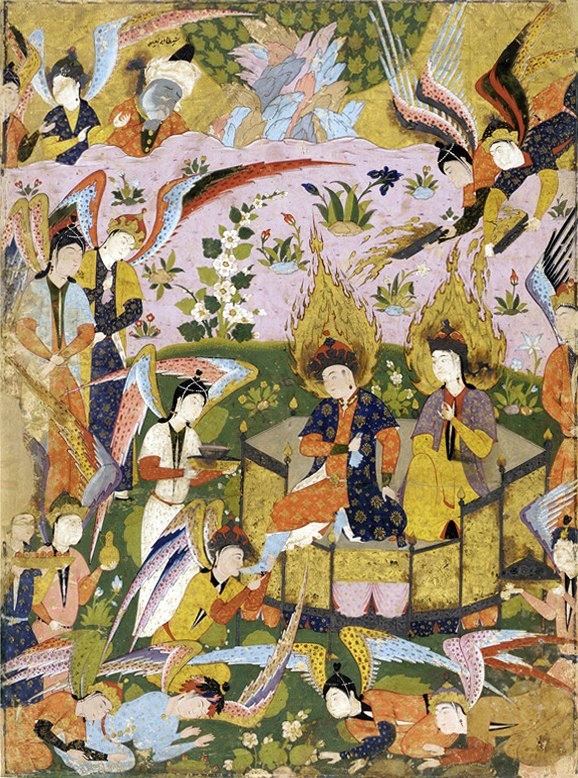
Picture: (Folio from a Falnama (Book of omens) Angels bow before Adam and Eve in Paradise mid Safavid period Opaque watercolor and gold on paper H: W: cm Qazvin, Iran)

UN Facts and figures: Ending violence against women
http://www.unwomen.org/en/what-we-do/ending-violence-against-women/facts-and-figures